A Shady Rockery
How to solve a problem like a very shady and dry rockery that you inherited?

Introduction
When we moved into our current home in October 2015, we inherited a garden which mostly consisted of trimmed shrubs, hedges and lawn with a stream at the end. The ground rises at you approach the stream, which I now realise is actually a bund to prevent flooding into the garden.
At some point in the past, someone had decided to take advantage of this ground level rise and to create a rockery along with a pond which has since been filled in. The rockery is made up of large boulders and what we think used to be a waterfall running through the middle. There was also a blocked paved path dividing the top centre bed.
The whole area was planted with a mixed collection of plants, mostly shrubs which had become too large and out of scale. There was also ground elder (Aegopodium podagraria) throughout the whole area. Removal of the shrubs was one of the earliest jobs we decided to do to open up the area and see what space we had to play with. The second task was removal of the ground elder, that took a while. Every other plant was carefully removed and potted up, whilst we tackled the ground elder. The whole area was left uncultivated for 2 years.
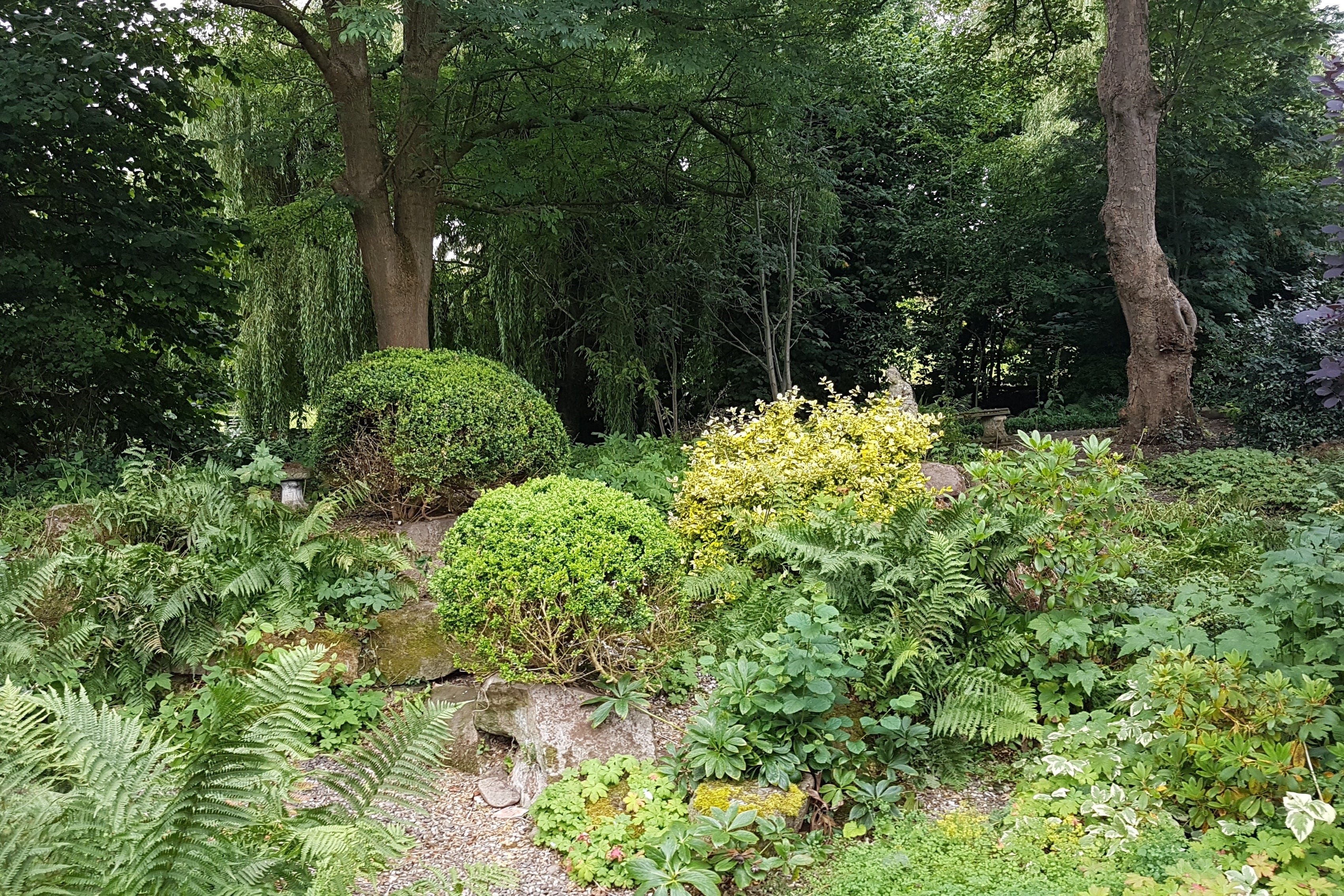
Woodland Rockery Before
The Woodland Rockery idea
Removing all of the plants, except for two established box balls (Buxus sempervirens) and a Euonymus fortunei ‘Emerald ‘n’ Gold’, gave me a chance to really see the size and shape of the rockery, and to assess the opportunities for planting. A traditional rockery was a non-starter, simply not enough sunshine. What we did have were these large boulders covered in moss under a large Ash and even larger Sycamore tree. Very shaded from April onwards, and I noticed extremely dry in the summer.
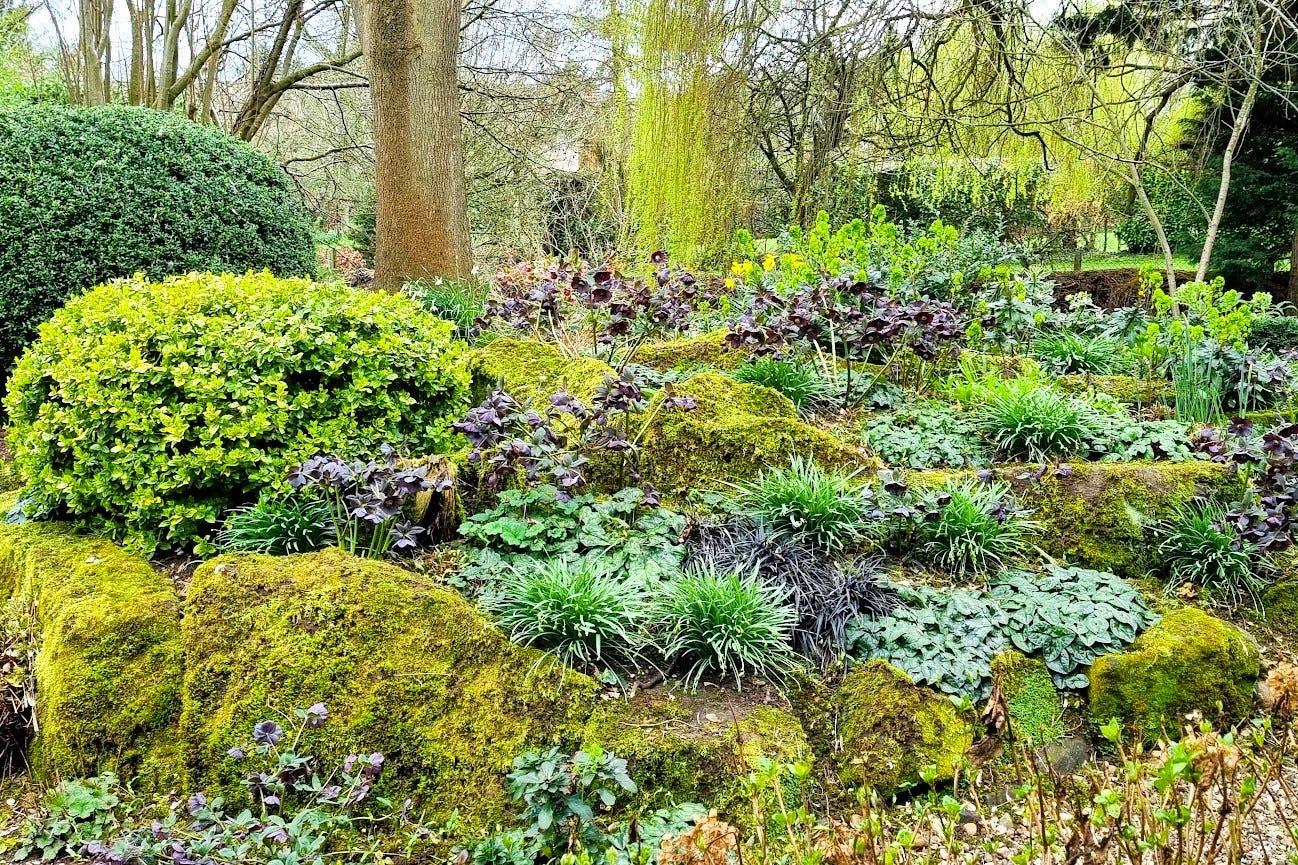
My solution was to try and create something like a woodland rockery, woodland plants in a rockery setting, as though as the woodland had naturalised a pile of boulders along its margin. I also had the start of a colour theme. We inherited an amazing almost black Hellebore, the black grass Ophiopogon planiscapus Nigrescens and some lime green Euphorbia amygdaloides var. Robbiae, so the idea of blacks, dark purples, contrasting with lime greens became something of a colour palette, complemented with rosy pinks and mid green foliage.
I set about researching plants which would tolerate the conditions to draw up a short list. Then we set about plant shopping, which has got to be the best part of creating any new planted area. In the interests of keeping my posts visual, here’s a seek peak at the finished result, after the initial planting.
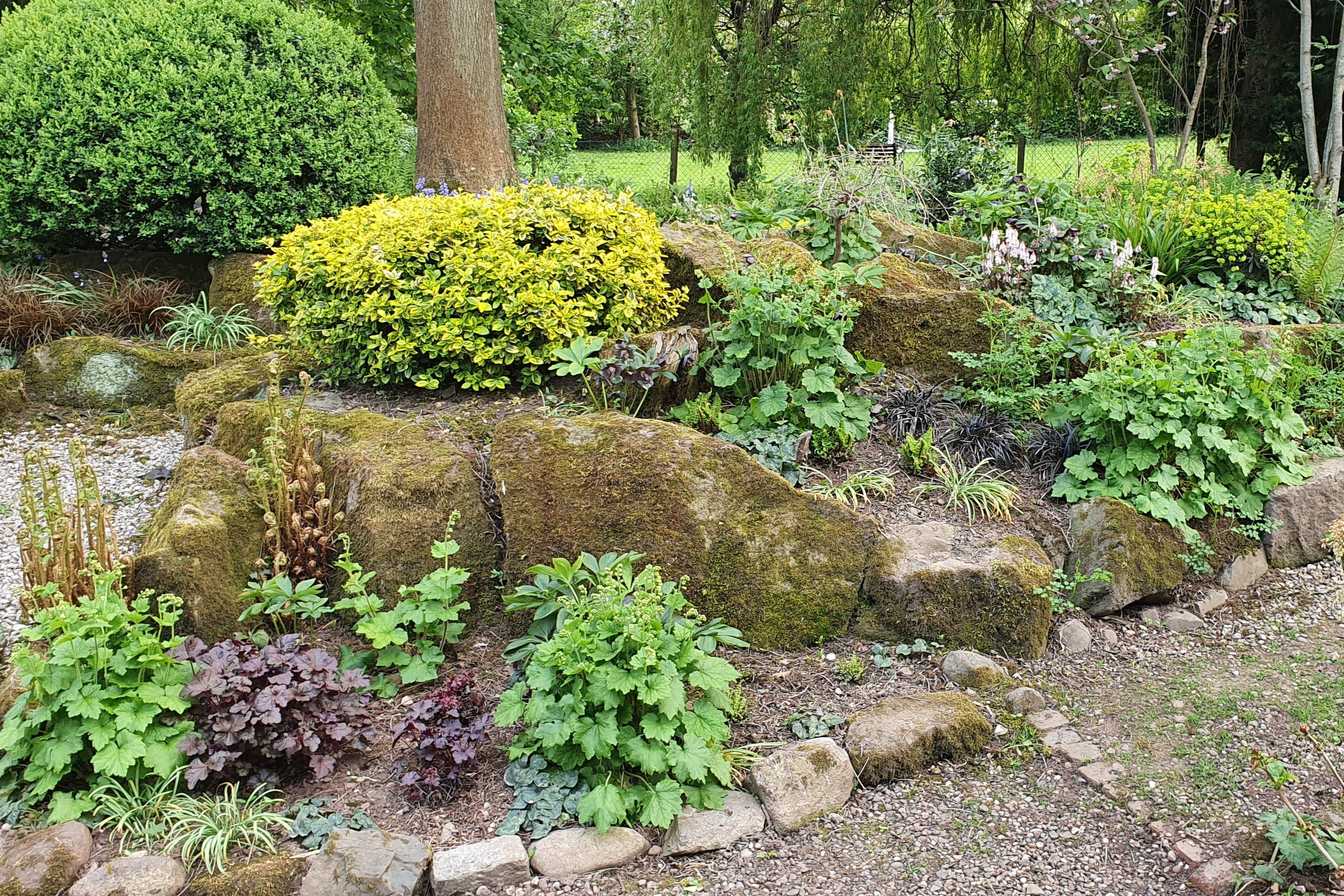
Woodland Rockery First Year
What are the problems with shady plots?
I think it’s important to take some time to understand the issues that any gardener is going to face with a shady border or in this case a rockery. There are two key factors to take into account.
· Lack of sunshine
· Lack of ground moisture.
Let’s look at each one in a bit more detail.
Lack of sunshine
Every plant has evolved and adapted to suit a particular set of growing conditions, and shade is one of those conditions. The plants that do best in the woodland setting adopt one of two methods to cope with the shade.
They take advantage of a short growing season, from Jan/Feb through to April/May to grow and flow. A great example of these are bulbs, where their early flowering provides seasonal interest when there are no leaves on the trees to shade the area.
Some plants have adapted to need less chlorophyll and can tolerate a shady spot as they need less sunlight. Chlorophyll absorbs light and is key to photosynthesis, the process by which plants make energy for themselves to grow and remain healthy.
It’s really important to choose plants which don’t need much sunlight to survive and grow, otherwise they won’t thrive.
There is a potential other solution, which is to create more light. Even in the shadiest spot some careful pruning can help let more sunlight in. Removing the odd tree branch can make a huge difference, and that’s something I’m quite happy to do. The greater the light levels, the wider the range of plants you’ll be able to grow in your shady area.
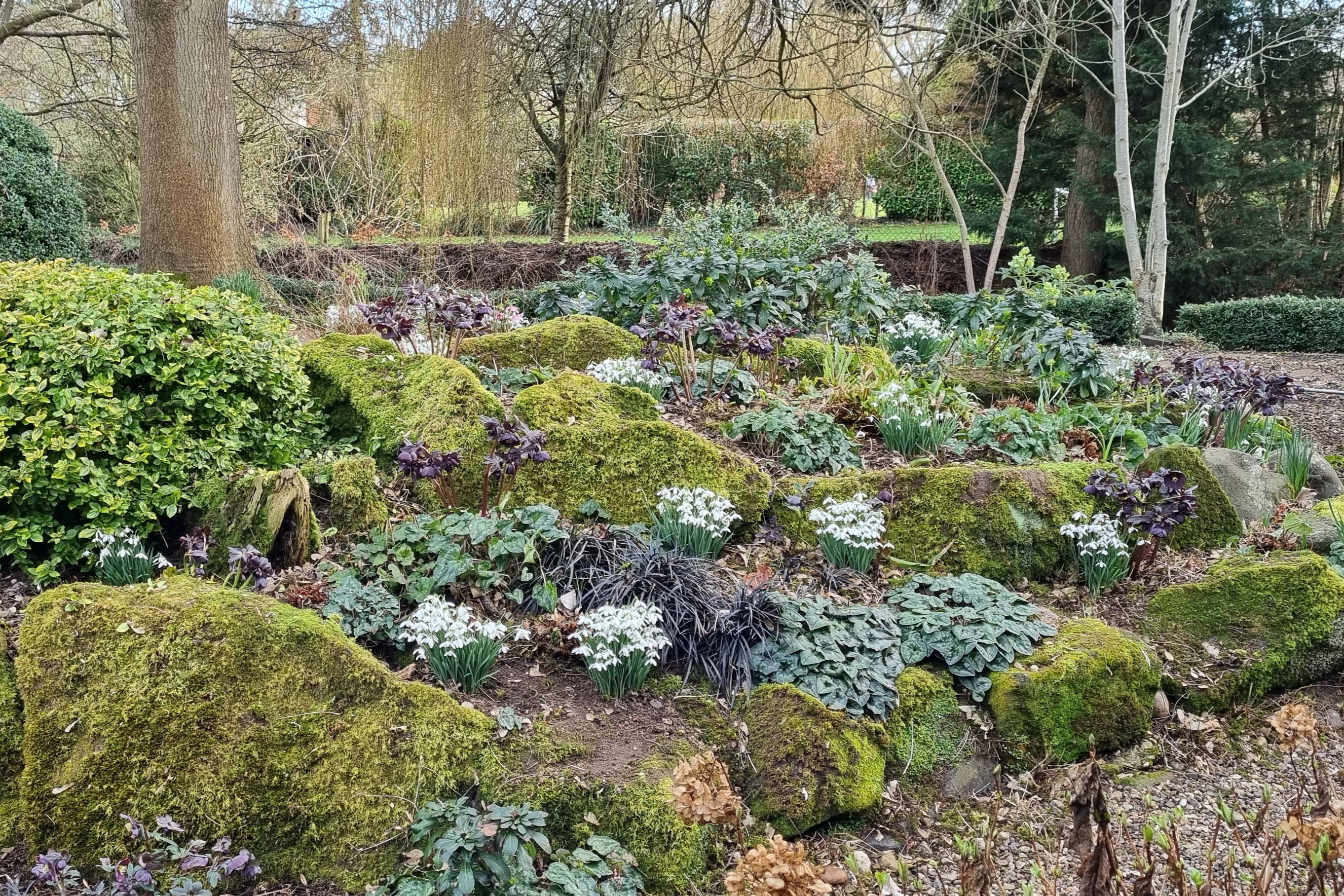
The Woodland Rocker at end of January
Lack of ground moisture
During the winter months, plants under deciduous trees receive as much rainfall as the rest of the garden. This period, when there are no leaves on the trees, is the window for those winter and spring flowering plants and bulbs to really get a move on and produce that all important early season display.
However, during the summer it’s a different matter, the leaves on the trees create a rain stopping canopy which prevents water reaching the ground unless the rain is really heavy. The best way to help plants in this situation is to improve the soil as much as possible. Dig in as much organic matter as possible before planting and then regularly mulch in early spring. Preferably mulch with leaf mould however any organic homemade compost will help. Mulching is vital as it not only locks in moisture in the soil, but also helps feed the soil. Your worm population will gradually pull the compost down into the soil to form humus, which helps to retain moisture.
If you have heavy soil, you may want to add some grit to break the soil up and improve the drainage.
The Plants
Well, I think that’s enough about the problems with shady borders, let’s look at some of the gems that you can plant to make your shady border really come alive. The first thing I would do is to be a bit nosey and see what’s going on in my neighbours’ gardens. You can do the same by going for a walk to see what’s growing and thriving locally. This will give you really useful insights into what might do well in your garden.
I’ve split the plants below into groups which will help you decide exactly what you want in your shady border or rockery.
Shrubs
For planting under trees, I think smaller shrubs are better in terms of size and scale, we don’t want something which is going to try and catch up with the tree. Here are a few good performers.
Daphne Odora Aureomarginata
Euonymus (most evergreen varieties will cope with shade)
Sarcococca Hookeriana Var. Digyna
Sarcococca confusa
Skimmia japonica 'Fragrans'
Skimmia japonica 'Rubella'
Spreaders
I think of these as the ground cover plants that will, in the long run, save you from weeding, and provide evergreen interest, even in the winter.


Anemanthele Lessoniana
Anemone japonica ‘Honorine Jobert’ (or any of the Japanese anemones, though beware they can be thuggish in the garden)
Cyclamen hederifolium
Epimedium rubra
Epimedium Sulphureum Versicolor
Euphorbia amygdaloides var. Robbiae (can spread and wander around the border)
Geranium Macrorrhizum (available in a range of colour, white through to deepest pink)
Ophiopogon planiscapus Nigrescens
Soleirolia soleirolii (beware that it doesn’t become too rampant, but does need some dampness)
Clumpers
These tend to create large clumps, so plant up in threes to create more impact or singularly as a feature or statement plant.


Brunnera macrophylla
Dryopteris filix-mas
Geum ‘Maddy prior’
Hellebores (there’s a huge range of colours, but they do like a humus rich soil)
Heuchera (a wide range to choose from, however the lime green ones seem do well in a shady spot)
Luzula sylvatica
Polystichum setiferum
Tellima grandiflora
Tiarella Spring Symphony
Don’t forget to include some spring flowering bulbs too, dwarf Narcissus, Snow Drops and of course Bluebells. Bulbs will open the season in late January and then close it as May approaches. I’ve included some of my favourite shade loving plants in this post however there are many more plants out there that will be perfect for your shady spot.
My favourite time for the Woodland Rockery is March, when the deep purple hellebores are in full swing, and the euphorbia creates a vivid lime splash as a contrast. The leaves are not back on the trees yet, so it’s not quite so shady.